




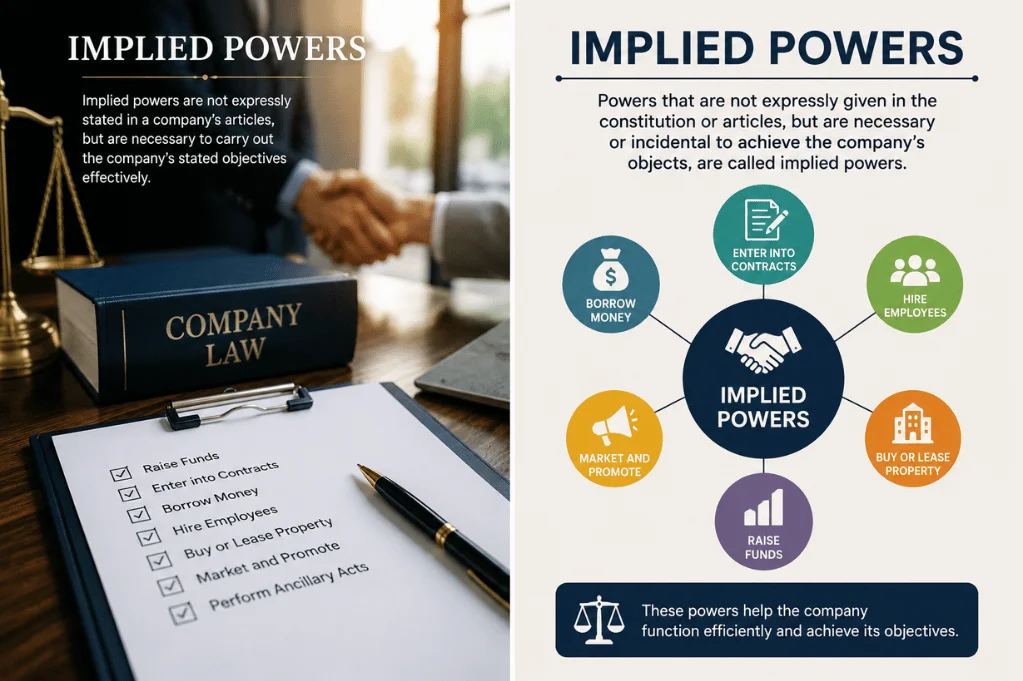
Implied powers are federal authorities that aren’t written word-for-word in the U.S. Constitution but are reasonably connected to duties the Constitution does grant. They let Congress choose practical ways to carry out its responsibilities. The Necessary and Proper Clause provides the main constitutional basis for this authority.
| Key point | What it means |
|---|---|
| Constitutional basis | Article I, Section 8, Clause 18 |
| Common name | Necessary and Proper Clause, sometimes called the Elastic Clause |
| Main purpose | Lets Congress use appropriate means to carry out constitutional duties |
| Landmark case | McCulloch v. Maryland (1819) |
| Classic example | Creating a national bank |
| Main limit | Federal action must connect to constitutional authority and respect other constitutional restrictions |
Direct answer: Congress may take actions that the Constitution does not specifically name when those actions help execute authority the Constitution does grant. The action must serve a legitimate federal purpose, have a reasonable connection to that purpose, and remain consistent with other constitutional limits.
For more introductory material on government, law, and related subjects, readers can also browse the Newsstact Education section.
Key takeaways
- Congress does not receive unlimited authority simply because an action seems useful.
- The constitutional foundation usually starts with an expressly granted duty.
- The Necessary and Proper Clause lets lawmakers select reasonable methods for carrying out that duty.
- McCulloch v. Maryland established the classic framework for analyzing this authority.
- The Tenth Amendment and federalism still place limits on congressional action.
How implied powers work under the Necessary and Proper Clause
Article I, Section 8 lists major congressional responsibilities, including taxation, borrowing, interstate commerce, and national defense. Clause 18 then allows Congress to make laws that are “necessary and proper” for carrying out constitutional authority.
“Necessary” does not mean that Congress may act only when no alternative exists. The Supreme Court has long read the clause more broadly. Modern doctrine permits measures that are reasonably connected, useful, or conducive to carrying out a constitutional responsibility.
That distinction matters. Congress still needs a constitutional starting point. The clause supplies a means of carrying out federal responsibilities rather than an independent license to legislate on any subject.
Why McCulloch v. Maryland matters
The defining case is McCulloch v. Maryland. The National Archives record of the 1819 decision shows that Congress had created the Second Bank of the United States even though the Constitution never expressly authorized a national bank.
The Supreme Court upheld Congress’s action. The bank was an appropriate tool for carrying out responsibilities involving taxation, borrowing, and other federal financial functions. The Court also ruled that Maryland could not tax the federal institution in a way that interfered with national authority.
The decision established a practical test: begin with a legitimate constitutional goal, then ask whether the chosen method reasonably helps achieve it and is not constitutionally prohibited.
Readers interested in other legal explainers can explore the Newsstact Law section.
7 examples and the constitutional authority behind them

The easiest way to understand the doctrine is to connect each action to the responsibility it helps Congress perform.
| Example | Constitutional starting point | Why the connection matters |
|---|---|---|
| 1. Creating a national bank | Taxing, borrowing, spending, and commerce | McCulloch upheld the authority of a bank as an appropriate means of carrying out federal financial duties. |
| 2. Establishing tax-collection agencies | Authority to levy and collect taxes | Congress needs administrative machinery to assess and collect revenue, and it created the Office of Commissioner of Internal Revenue in 1862. |
| 3. Using a military draft | Authority to raise and support armies | The Supreme Court upheld compulsory military service during World War I against constitutional challenges. |
| 4. Creating a separate U.S. Air Force | National defense and military authority | The National Security Act of 1947 established the Air Force, even though the Constitution names only the Army and the Navy rather than an Air Force. |
| 5. Operating a federal criminal justice system | Federal laws based on constitutional responsibilities | Courts, prosecutors, prisons, and enforcement mechanisms may be needed to make valid federal criminal statutes workable. |
| 6. Addressing the consequences of federal imprisonment | Administration of the federal criminal system | In United States v. Comstock, the Court upheld a federal civil commitment law under the Necessary and Proper Clause. |
| 7. Making paper notes legal tender | Borrowing, taxation, money, and commerce | Constitution Annotated identifies legal tender legislation as another example considered under Congress’s constitutional financial authority. |
These examples show a useful pattern. The Constitution assigns the federal government a task, while legislation provides the practical tools to carry it out.
Enumerated authority vs. implied authority
Enumerated powers are written directly into the Constitution. Congress can tax, borrow money, regulate interstate commerce, coin money, and raise armies because the constitutional text expressly grants those responsibilities.
Implied authority works one step later. It concerns the methods Congress may use to make those written responsibilities effective. Constitution Annotated describes this relationship as the authority needed to effectuate what the Constitution already grants.
A simple comparison helps:
Enumerated: Congress may collect taxes.
Implied: Congress may create administrative offices, procedures, records, and enforcement systems needed to collect those taxes.
The second does not replace the first. It depends on it.
What limits Congress?
The doctrine is broad, but it is not a blank check. First, a federal law must be connected to authority granted by the Constitution. Congress cannot turn the Necessary and Proper Clause into an independent source of general legislative control.
Second, the chosen means must remain constitutional. McCulloch emphasized that an action cannot violate the Constitution while claiming to carry out another constitutional responsibility. Federalism adds another boundary. The Tenth Amendment reserves undelegated authority to the states or the people.
The Supreme Court has also held that Congress generally cannot force state officials to administer a federal regulatory program. Constitution Annotated explains that such interference with state sovereignty may fail the “proper” part of the clause.
This is why disputes over federal authority often ask two separate questions: Does Congress have a constitutional objective, and is its chosen method constitutionally permissible?
Why this constitutional idea still matters
A Constitution written in the eighteenth century could not name every institution or administrative system that a modern government would eventually use. The doctrine gives Congress room to adapt while keeping federal action tied to the Constitution.
It explains how written responsibilities can support later institutions without requiring a constitutional amendment for every new administrative method. It also explains why arguments over federalism continue. The dispute is often not about whether Congress has any authority. The harder question is how far lawmakers may go while carrying out that authority.
The bottom line
The Constitution gives Congress defined responsibilities without attempting to list every tool lawmakers may ever need. The Necessary and Proper Clause bridges that gap. When evaluating a federal action, trace it backward.
Identify the constitutional responsibility, identify the method Congress selected, and ask whether that method reasonably carries out the responsibility without violating another constitutional rule.
For more educational and general-interest explainers, visit the Newsstact homepage.
Frequently asked questions
They are authorities that the Constitution does not spell out directly but that Congress may use to carry out responsibilities the Constitution does grant. The Necessary and Proper Clause is the main textual basis for this principle.
Creating a national bank is the classic example. The Supreme Court upheld that action in McCulloch v. Maryland because a bank could help Congress carry out financial responsibilities such as taxation and borrowing.
The nickname reflects its flexibility. Congress can select appropriate methods for implementing constitutional responsibilities even when those specific methods are not listed in the document. Legal reference sources note that the “Elastic Clause” is one of several names used for the provision.
No. A federal action still needs a constitutional basis and must comply with other constitutional restrictions. Principles of state sovereignty can also make an otherwise useful federal measure unconstitutional.
