



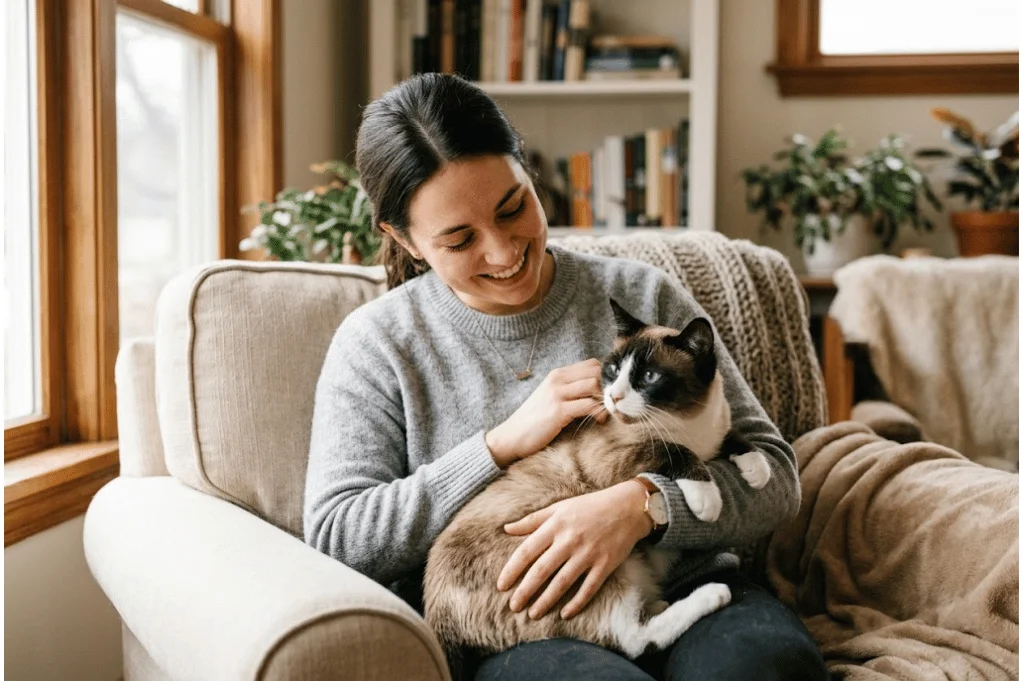
A Snowshoe cat is hard to mistake once you know what to look for: vivid blue eyes, darker color points, and crisp white paws that look like tiny boots. Yet appearance is only part of the appeal, because these cats are also known for intelligence, affection, playfulness, and unusually strong bonds with their people. For U.S. families considering the breed, the bigger questions involve temperament, daily care, health, availability, and whether a highly social cat fits the household.
Short answer: The Snowshoe cat is a rare, medium-sized American breed known for blue eyes, pointed coloring, white feet, intelligence, and an affectionate personality. Most are active and people-oriented, need only light coat maintenance, and can live well into their teens when given appropriate nutrition, enrichment, veterinary care, and companionship.
The Breed at a Glance
| Trait | What to Expect |
|---|---|
| Origin | United States; developed in Philadelphia in the 1960s |
| Adult size | Females about 7–10 lb; males about 9–12 lb |
| Coat | Short, smooth, single-layer coat |
| Eye color | Blue |
| Common colors | Seal point and blue point |
| Personality | Affectionate, intelligent, curious, social |
| Vocal level | Moderate; generally softer than a Siamese |
| Grooming | Weekly brushing is usually sufficient |
| Activity | Active and playful |
| Family fit | Often good with respectful children and other pets |
| Lifespan | Commonly around 14–20 years, with individual variation |
| Availability | Relatively rare |
TICA describes the breed as a balanced, muscular but agile cat rather than a heavy or bulky one. Adult females are generally smaller than males, while the coat remains short and relatively easy to maintain. PetMD gives a broader overall size range of about 7–14 pounds, reflecting the natural variation found among individual cats.
What Is a Snowshoe Cat?
The Snowshoe is a pedigreed cat breed developed from Siamese and shorthair cats with prominent white markings. Its signature combination includes Siamese-style point coloring, blue eyes, and white feet, while many individuals also display a white inverted-V pattern across the face. The breed takes its name from those distinctive white paws, which can make the cat look like it’s wearing small snow boots.
That appearance is not as easy for breeders to reproduce as it might seem. White spotting can vary significantly from kitten to kitten, so an otherwise healthy purebred Snowshoe does not necessarily have perfectly symmetrical facial markings or show-ring-quality boots. This unpredictability is one reason the breed remains much less common than better-known cats such as the Siamese, Ragdoll, or American Shorthair.
Where Did the Snowshoe Breed Come From?
The breed’s story begins in Philadelphia, Pennsylvania, during the early 1960s. According to The International Cat Association, breeder Dorothy Hinds Daugherty discovered three Siamese kittens with four white feet and began developing a new breed around the unusual combination. She later bred the cats with a shorthaired domestic cat with tuxedo-style markings, helping establish the characteristic white facial pattern associated with the breed today.
The Snowshoe came surprisingly close to disappearing during its early development. TICA reports that interest fell so sharply that only one breeder remained in 1977, although breeder numbers recovered during the following decade. TICA eventually accepted the Snowshoe for championship competition in 1994, helping give the breed greater visibility and formal recognition.
What Does a Snowshoe Cat Look Like?
The classic Snowshoe combines a light-colored body with darker ears, face, legs, and tail, plus white feet that contrast sharply with the points. Seal point and blue point are among the most common colors, while lighter shades such as chocolate and lilac are less frequently seen. The eyes are blue, and the body should appear athletic and muscular without looking overly heavy.
One of the breed’s more surprising features appears during kittenhood. Snowshoe kittens are born white, and their darker point colors begin developing over the following weeks as they grow. Color and contrast may continue to change as the cat matures, so the markings on a very young kitten may not reflect exactly how the adult cat will look.
Not every pointed cat with white feet is a pedigreed Snowshoe. Domestic cats and Siamese mixes can look remarkably similar, especially when they have blue eyes and white spotting. If pedigree matters to you, registration records and breeder documentation are more reliable evidence than coat pattern alone.
Personality and Temperament
Most Snowshoes are strongly people-oriented, curious, affectionate, and intelligent. TICA notes that personalities still vary considerably, with some individuals acting shy, others becoming confidently bossy, and others developing a particularly nurturing attachment to their favorite person. That individuality means buyers should meet a kitten or an adult cat when possible, rather than assuming every Snowshoe will behave exactly as a breed description suggests.
Their Siamese ancestry often shows in their willingness to communicate, although the voice is typically described as softer and more melodic than the classic Siamese call. Many follow family members from room to room, investigate household activity, and want to participate rather than observe from a distance. A person looking for an independent cat that spends most of the day alone may therefore find the breed more demanding than expected.
Intelligence is another defining characteristic. Snowshoes can learn routines quickly and may enjoy fetch, clicker training, puzzle feeders, leash work, and other activities that turn attention into a game. PetMD recommends providing climbing areas, scratching surfaces, interactive toys, and regular play to channel that combination of intelligence and physical energy.
Are They Good Family Pets?
A properly socialized Snowshoe can be an excellent family companion because the breed usually enjoys interaction rather than avoiding it. Many live comfortably with respectful children, other cats, and cat-friendly dogs, though successful relationships still depend on personality, introductions, and how children handle animals. Breed tendencies can guide expectations, but they cannot guarantee that two individual pets will immediately get along.
Introduce new animals gradually, giving each pet its own food, water, resting places, and escape routes during the transition. A cat should always have vertical space or a quiet room where it can disengage from an excited dog or child without being followed. If a dog in the household also needs behavioral work, Newsstact’s guide to choosing a dog trainer offers additional considerations for evaluating professional training support.
Can a Snowshoe Be Left Alone All Day?
This is one of the most important ownership questions because Snowshoes tend to place a high value on companionship. TICA specifically describes the breed as very social and advises against leaving these cats alone for long periods, while individual cats can still differ in how strongly they seek company. A predictable workday may work for some adults, but repeated long stretches without interaction aren’t ideal for a highly social individual.
Owners who work outside the home can make the environment more engaging with window perches, climbing furniture, rotating toys, food puzzles, and structured play before and after work. Some Snowshoes may also benefit from living with another compatible pet, provided introductions are handled correctly. The key is to treat social interaction and mental activity as normal care needs, not optional extras.
Exercise, Play, and Training Needs
A Snowshoe does not need a backyard to exercise, but it does need opportunities to climb, chase, jump, investigate, and solve problems. Cat trees, wand toys, tunnels, sturdy scratching posts, puzzle feeders, and short training sessions can provide more value than simply leaving a basket of toys on the floor. PetMD suggests multiple short, interactive play sessions throughout the day to help meet the activity needs of energetic cats.
Training should rely on rewards rather than punishment. Use small food rewards, toys, praise, or clicker training to reinforce behaviors such as entering a carrier, coming when called, using a scratching post, or walking into a harness. Intelligent cats often learn quickly, but consistency matters more than trying to teach several behaviors at once.
Many Snowshoes are also unusually interested in water. Individual cats may investigate faucets, paw at water dishes, or show interest in tubs and sinks, although owners should never assume every member of the breed wants to swim. Supervise water play, and keep deep containers, toilets, cleaning solutions, and other household hazards out of reach.
Grooming and Coat Care
Grooming is one of the easier parts of Snowshoe ownership. TICA describes the coat as short and single-layered, and recommends brushing roughly weekly to remove loose hair and distribute natural skin oils. Routine brushing also lets you notice skin irritation, lumps, parasites, or early changes in coat condition.
Basic grooming should extend beyond the coat. Nails need regular trimming, teeth benefit from brushing with veterinary-approved toothpaste, and the ears should be checked for unusual odor, debris, redness, or irritation. Regular veterinary examinations and professional dental care when recommended remain important even for a cat that looks perfectly healthy.
Bathing is usually not required unless the cat becomes unusually dirty or a veterinarian recommends it for a medical reason. A greasy, neglected, or suddenly unkempt coat can sometimes indicate that a cat is no longer grooming normally. Rather than simply bathing away the symptom, owners should consider whether discomfort, illness, obesity, dental pain, or stress could be interfering with self-grooming.
Health and Lifespan
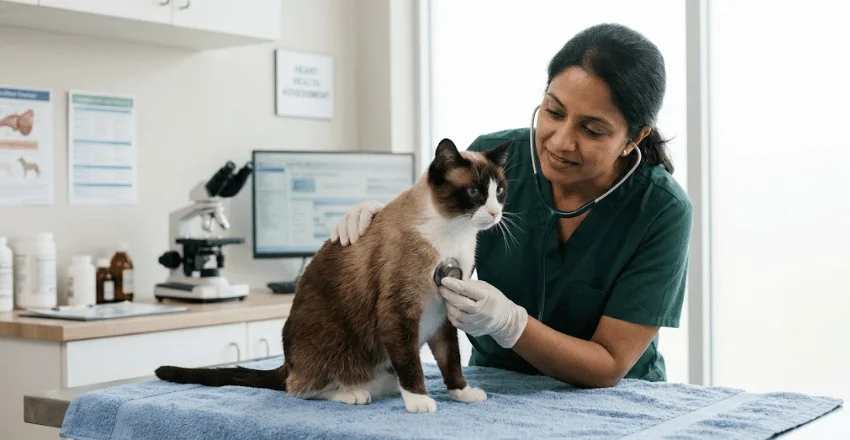
The Snowshoe is generally regarded as a healthy breed, but “healthy breed” does not mean an individual cat cannot develop serious disease. PetMD lists a lifespan of approximately 14–20 years and discusses potential concerns, including hypertrophic cardiomyopathy (HCM) and pica, while TICA emphasizes routine vaccinations, parasite control, dental care, and veterinary checkups. Longevity depends on genetics, nutrition, body condition, preventive care, lifestyle, and factors that cannot always be predicted.
HCM causes abnormal thickening of the heart muscle and is generally the most common form of heart disease in cats. PetMD notes that no Snowshoe-specific genetic test currently exists, making veterinary examinations especially useful for evaluating heart health. Difficulty breathing, fainting, unusual weakness, reduced appetite, or sudden exercise intolerance should be treated as reasons to seek veterinary care, not symptoms to monitor casually at home.
Pica refers to eating or chewing non-food materials such as string, wool, plastic, or other household objects. The behavior can become dangerous when swallowed material causes an intestinal obstruction or when a cat consumes something toxic. Owners of any curious cat should secure thread, ribbon, hair ties, rubber bands, toxic plants, medication, cleaning products, and similarly tempting hazards.
What Should the Breed Eat?
Snowshoes do not require a breed-specific diet simply because they have distinctive markings. A complete and balanced food appropriate for the cat’s life stage is the usual foundation, and PetMD recommends choosing products that meet Association of American Feed Control Officials nutritional standards. Portions should then be adjusted for age, weight, body condition, health, neuter status, and activity rather than relying on a universal feeding amount.
Weight management deserves attention even with an active breed. Free access to excess calories can gradually turn a muscular cat into an overweight cat, increasing strain on joints and complicating other health problems. A veterinarian can help establish an appropriate target weight and daily calorie intake if the feeding directions on the package do not match the individual cat.
Fresh water should always be available. Some cats drink more readily from fountains or from water placed away from the food bowl, while wet food can also contribute to overall moisture intake. Significant changes in thirst, appetite, urination, or weight should be discussed with a veterinarian rather than corrected solely by changing food brands.
How Much Does One Cost in the U.S.?
Purebred Snowshoes can be expensive because breeder availability is limited and desirable markings are difficult to reproduce consistently. PetMD lists typical kitten prices at $2,000–$3,500, while Adopt a Pet provides a broader breeder estimate of $1,500–$4,000 and notes that shelter or rescue adoption is substantially less expensive. Actual prices depend on the breeder’s reputation, location, pedigree, health screening, registration, age, and whether the kitten is sold as a pet or a show prospect.
The purchase price should not be the only factor in the decision. New owners may also need a carrier, litter boxes, scratching furniture, food dishes, toys, initial veterinary care, vaccines, parasite prevention, spay or neuter surgery if not already completed, dental care, and emergency savings or pet insurance. Over a cat’s lifetime, routine and unexpected care can easily matter more financially than the original adoption or breeder fee.
A very cheap “purebred Snowshoe” should encourage questions rather than an immediate purchase. Ask for health records, registration details when pedigree is claimed, information about the parents, the kitten’s socialization history, and the breeder’s policy if the cat later cannot remain in your home. Reputable breeders should be as interested in where the kitten is going as the buyer is in obtaining it.
Adoption vs. Buying From a Breeder
Adoption is worth checking before assuming a breeder is the only route. Breed-specific rescues, Siamese rescues, local shelters, and national pet-adoption databases sometimes list cats described as Snowshoes or Snowshoe mixes. Because appearance alone cannot establish pedigree, adopters should prioritize health and temperament unless formal breed documentation is personally important.
Buying from a responsible breeder can make more sense for someone specifically seeking a pedigreed kitten with documented ancestry. Ask what health screening is performed on breeding cats, how kittens are socialized, at what age they go home, what veterinary care is completed first, and what the contract requires. Avoid sellers who refuse visits or video calls, pressure buyers to send money immediately, or cannot provide meaningful information about the kitten’s parents and living conditions.
Is the Breed Hypoallergenic?
No Snowshoe should be purchased on the assumption that the breed is hypoallergenic. Although the short single coat may shed less visibly than some longer or double-coated breeds, cat allergies are caused largely by proteins found in saliva and skin secretions rather than fur length alone. A person with significant cat allergies can therefore react to a Snowshoe just as they can react to another breed.
If allergies are a concern, spend substantial time around the specific cat before committing whenever possible. Reactions differ between people and can also vary between individual cats, making a breed label an unreliable substitute for real exposure. People with asthma or severe allergy symptoms should discuss pet ownership with an appropriate healthcare professional before bringing a cat into the home.
Snowshoe vs. Siamese: What Is the Difference?
The Siamese connection is obvious because both breeds typically have blue eyes and pointed coloring. A Snowshoe adds prominent white spotting, including the namesake white feet, and generally has a somewhat sturdier, more muscular build. Snowshoes are also commonly described as conversational but softer-voiced than the famously vocal Siamese.
Temperament overlaps considerably, particularly in intelligence, curiosity, social attachment, and willingness to interact with people. However, breed averages should not be turned into rigid personality rules, because individual Siamese and Snowshoes can be quiet, outgoing, cautious, demanding, or unusually independent. Choosing based on the cat’s actual behavior and the household’s lifestyle is more useful than choosing only from a comparison chart.
Is This Breed Right for You?
A Snowshoe can be an excellent choice for someone who wants a cat that is visibly involved in family life. Owners should be comfortable providing conversation, daily play, climbing opportunities, enrichment, routine veterinary care, and enough companionship to prevent an intelligent cat from becoming bored. The short coat keeps grooming manageable, but the social and mental needs can be greater than the coat-care requirements suggest.
Consider another type of cat if your main priority is an extremely independent pet that rarely asks for interaction. The breed may also be a poor match if everyone is routinely away for very long days and there is little opportunity for morning or evening engagement. Choosing for lifestyle compatibility matters more than choosing for blue eyes, white paws, or social-media appeal.
For households prepared for that level of involvement, the reward can be a loyal, entertaining companion with an unusually expressive personality. Snowshoes combine athletic play with affection and tend to turn ordinary household routines into opportunities for participation. Readers exploring additional animal-care topics can browse the Newsstact Pets section for more pet-focused guides.
The Bottom Line
The breed combines a striking appearance with a personality that is intelligent, affectionate, active, and deeply social. Its short coat is relatively easy to maintain, while companionship, enrichment, preventive healthcare, and responsible feeding require more ongoing attention than grooming does. For a U.S. household that wants an interactive feline companion rather than a distant one, the breed can be an excellent fit.
Choose the individual cat as carefully as you choose the breed. Meet the cat when possible, verify breeder or rescue information, budget for lifetime veterinary care, and think realistically about how many hours of companionship your household can provide. Those decisions will matter far more to daily life than whether every white paw or facial marking is perfectly symmetrical.
Frequently Asked Questions
Are Snowshoe cats rare?
Yes, genuine pedigreed Snowshoes remain relatively uncommon compared with major breeds such as the Siamese or Ragdoll. Historically, the breed had a very small breeder population, and consistently producing the desired white markings is genetically difficult. Cats with a Snowshoe-like appearance are easier to find, but appearance alone does not prove pedigree.
Do Snowshoes meow a lot?
Many Snowshoes are talkative because of their Siamese ancestry, but their voices are commonly described as softer and more melodic. Individual vocal behavior varies, and boredom, hunger, changes in routine, stress, or illness can also influence how often a cat calls for attention. A sudden major increase in vocalization deserves investigation rather than being dismissed as a breed trait.
How long do Snowshoes live?
PetMD places the typical Snowshoe lifespan at around 14–20 years, while TICA notes that some may reach 15–20 years or beyond depending on numerous factors. Genetics alone does not determine lifespan because weight, indoor safety, nutrition, dental care, preventive medicine, and early treatment of illness can all affect longevity. Regular veterinary care is therefore more useful than treating any breed lifespan estimate as a guarantee.
Do Snowshoes like water?
Many Snowshoes have a reputation for being unusually interested in water. Some may play with faucets, investigate sinks, or splash in shallow water, but this is a tendency rather than a requirement of the breed. Never place a reluctant cat in water simply because Snowshoes are sometimes described as swimmers.
Are Snowshoes good with dogs?
They often can be, especially when both animals have suitable temperaments and are introduced gradually. Give the cat safe, elevated areas, and avoid forcing face-to-face interaction until both pets are relaxed around each other’s scent and presence. A friendly breed reputation cannot replace careful introductions, supervision, and respect for the individual animals.
How can I tell whether my cat is really a Snowshoe?
Blue eyes, pointed coloring, white paws, and an inverted white facial marking can make a cat look strongly Snowshoe-like. Those features can also appear in mixed-breed cats, so they cannot establish pedigree on their own. Registration papers or verifiable breeder records are the most reliable way to confirm that a cat belongs to a documented Snowshoe line.
