




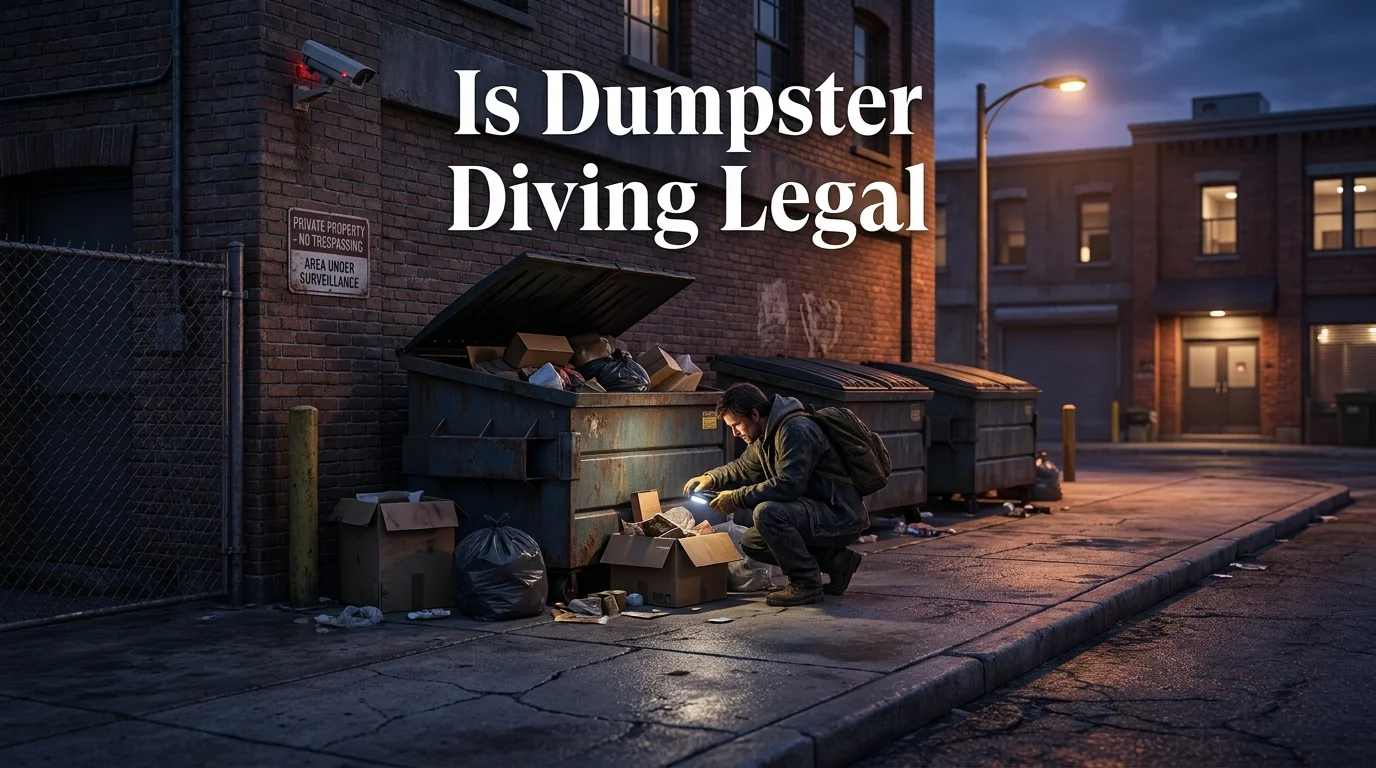
If you’re asking if dumpster diving legal in the United States, the short answer is: sometimes. No single federal law creates a blanket ban on searching discarded trash, but the location and local rules can change the answer. A bag placed at a public curb presents a different legal situation from a locked dumpster behind a private business. More from us: Tortious Interference.
| Legal question | General U.S. rule |
|---|---|
| Federal baseline | No general federal law bans searching discarded trash |
| Curbside trash | May have less privacy protection, but local rules can still restrict removal |
| Private property | Trespass laws can apply |
| Fences and gates | Strong warning that access is restricted |
| Locked dumpsters | Do not force, cut, break, or bypass a lock |
| Store dumpsters | Often located on private commercial property |
| Local ordinances | Some cities expressly prohibit scavenging from trash or recycling |
| Best precaution | Check the local code and obtain permission when possible |
Direct answer: Dumpster diving is not banned by one nationwide federal law, but that does not make every dumpster fair game. Where the trash sits, whether you have permission to be there, local scavenging rules, and any signs, fences, gates, or locks can determine whether taking discarded items creates legal trouble.
Key Takeaways
- The Supreme Court’s 1988 California v. Greenwood decision concerns privacy in garbage left for collection, not a universal right to take trash.
- Entering private or restricted property can expose you to trespass laws.
- A city or county can prohibit scavenging even where trash is accessible from a public area.
- Never climb a fence, open a restricted enclosure, defeat a lock, or ignore a request to leave.
- Commercial dumpsters deserve extra caution because parking lots, loading areas, and waste enclosures are commonly private property.
- When the local rule is unclear, checking the municipal code or asking the property owner is safer than assuming the trash is free to take.
What California v. Greenwood Really Says About Trash
The legal discussion usually starts with the U.S. Supreme Court’s decision in California v. Greenwood, 486 U.S. 35 (1988). The Court held that the Fourth Amendment does not prohibit a warrantless search of garbage left for collection outside the curtilage of a home. It reasoned that garbage exposed for collection in an area accessible to the public does not carry the same reasonable expectation of privacy as property kept inside the home.
That ruling is often described too broadly online. Greenwood addressed constitutional privacy and government searches; it did not announce that every discarded item belongs to anyone who finds it. Trespass laws, property rights, theft rules, and municipal waste ordinances remain separate legal questions.
This distinction matters whenever you see claims that the Supreme Court “legalized” the activity across America. A person can have little Fourth Amendment privacy in curbside garbage while a city still restricts who may remove that garbage. Readers interested in similar legal explainers can browse NewsStact’s Law coverage.
Is Dumpster Diving Legal on Public or Private Property?
Location is often the most important practical factor. Trash placed beside a public street for collection creates fewer property-access concerns than a container located behind a building. Even at the curb, though, a local anti-scavenging ordinance may prohibit removing material.
Commercial dumpsters need more caution because the surrounding land can be privately owned. A shopping center parking lot may welcome customers, but that does not automatically mean every loading dock, service alley, or waste enclosure is open to the public. Posted restrictions, fences, gates, and instructions from an owner or employee can make the boundary clearer.
State trespass statutes illustrate why the property question matters. Texas Penal Code § 30.05, the state’s criminal trespass provision, addresses entering or remaining on another person’s property without effective consent after receiving specified forms of notice, which can include signs and fencing. New York law likewise defines trespass as knowingly entering or remaining unlawfully on premises.
| Situation | General risk level | Main issue to check |
|---|---|---|
| Loose item clearly placed for disposal beside a public curb | Lower | Local scavenging or collection rules |
| Residential garbage container at the curb | Medium | Municipal code and ownership rules |
| Dumpster in an open commercial parking area | Medium to high | Private-property permission |
| Dumpster behind a store or loading area | High | Trespass and restricted access |
| Fenced or gated waste enclosure | High | Clear access restriction |
| Locked container | High | Trespass, damage, or other property offenses |
| City recycling or refuse container | Varies | Municipal ownership and anti-scavenging rules |
Local Scavenging Laws Can Override the Easy Answer
Local ordinances are one reason a nationwide yes-or-no answer is misleading. Cities and counties often control garbage collection, recycling programs, public sanitation, and who may remove material placed for pickup. Their rules can be stricter than a person might expect after reading only about Greenwood.
Houston provides a current example. Its municipal code prohibits unauthorized people from scavenging, disturbing, or removing contents from certain garbage, trash, or recycling containers placed for collection. The provision shows why publicly accessible trash is not automatically free from local regulation.
Rochester, New York, also tells residents that individuals may not remove material placed between the sidewalk and curb for collection. Duarte, California, states that removing garbage or recyclables from solid-waste containers is prohibited under its municipal rules. These examples demonstrate that the answer can change from one city to another even when the federal constitutional rule stays the same.
Five Things That Can Turn a Trash Search Into a Legal Problem
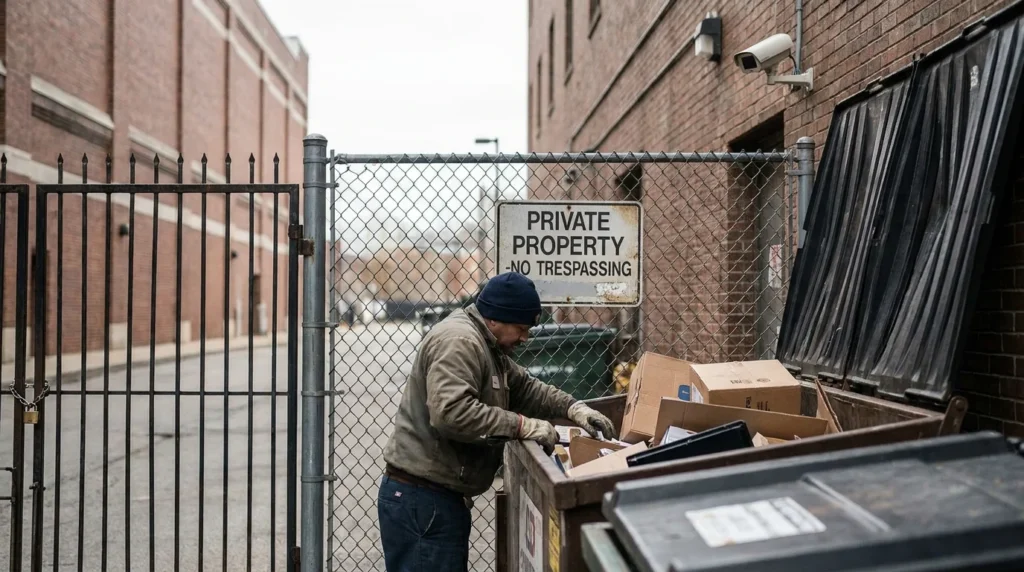
1. Trespassing
Crossing onto property where you lack permission can create a separate offense regardless of what is inside the dumpster. A posted sign, fence, gate, direct warning, or other restriction may provide notice that the area is off limits. If an owner, employee, security guard, or other authorized person tells you to leave, leaving promptly is the safer response.
2. A City or County Anti-Scavenging Rule
Search the local municipal code rather than relying on a national article alone. Useful terms include “scavenging,” “solid waste,” “refuse,” “recyclables,” “unauthorized removal,” and “collection containers.” Some local governments treat material placed for collection as controlled by the city or its authorized waste service.
3. Locks, Gates, or Property Damage
A locked lid or secured enclosure is a clear reason not to proceed. Cutting a lock, damaging a container, forcing a gate, or breaking other property can create issues that have nothing to do with the legal status of discarded trash. The safest rule is simple: never defeat a physical security measure to reach waste.
4. Taking Something That Was Not Abandoned
An object sitting near a dumpster is not necessarily garbage. Deliveries, reusable business equipment, returns, storage containers, and items temporarily placed outside may still have an owner. If it is unclear whether something was discarded, do not assume its location alone proves abandonment.
5. Creating a Separate Sanitation or Conduct Violation
Pulling items from a container and leaving waste scattered around can trigger rules on litter, sanitation, or property maintenance. Blocking traffic, creating excessive noise, or remaining in a restricted location can also draw attention to separate local rules. Leaving an area undisturbed does not guarantee legality, but creating a mess can add another problem.
What About Dumpsters Behind Retail Stores?
A retailer throwing something away does not automatically give the public permission to enter the retailer’s property and retrieve it. The container may sit in a private loading area, behind a store, beside an employee-only entrance, or inside a waste enclosure. Those facts can matter more than whether the products inside appear unwanted.
Permission gives you a clearer answer than guesswork. If a store manager or property representative authorizes removal, keep the permission within the limits they gave you. If the business prohibits it or asks you to leave, do not argue that the Supreme Court gives you a right to remain.
Apartment and condominium dumpsters present similar questions. A resident’s right to use common property does not necessarily include permission to sort through shared waste or take other residents’ discarded belongings. Lease terms, property rules, local ordinances, and access restrictions can all affect the answer.
Are the Rules the Same in All 50 States?
There is no single federal prohibition that makes the activity automatically illegal everywhere in America. That federal starting point does not produce one uniform rule because states have their own trespass and property statutes, while cities and counties regulate waste collection. A legal answer should therefore identify the exact state and municipality before reaching a firm conclusion.
This is also why a “50-state legal” label can give readers false confidence. The relevant question is not only whether a state has a statute named “dumpster diving,” but whether trespass, theft, sanitation, recycling, or local scavenging provisions cover what you plan to do. NewsStact’s broader Education section includes other explanatory material built around similar distinctions.
The safest interpretation is conditional rather than absolute. Lawfully accessible discarded material may present fewer risks, while restricted property and cities with anti-scavenging rules present much more risk. When legal consequences matter, check the current code rather than relying on a state-by-state social media chart.
How to Check the Law Before Taking Anything
- Identify where the container is located. Determine whether you would remain on a public area or enter private property.
- Look for restrictions. Check for fences, gates, locks, employee-only markings, or “No Trespassing” signs.
- Search the municipal code. Use terms such as “scavenging,” “refuse,” “solid waste,” “recycling,” and “removal.”
- Review your state’s trespass rules. Pay attention to how the state defines notice, consent, and restricted premises.
- Ask the owner or manager when practical. Clear permission removes much of the uncertainty about access.
- Leave when told to leave. Do not turn a disagreement over unwanted goods into a trespass dispute.
Municipal codes change, so check the city or county’s current official website before relying on an old forum post. If a rule refers to refuse becoming city property after collection placement, read the exact language and definitions. A local attorney can interpret the provision when a citation, arrest, or other significant consequence is involved.
Can You Be Ticketed or Arrested?
Yes, depending on the facts and the law that applies. Police may investigate conduct around a dumpster when there is a complaint about trespassing, property damage, theft, littering, or a municipal scavenging violation. Whether the incident leads to a warning, citation, arrest, or no action depends on the jurisdiction and circumstances.
Do not assume that the absence of a law named “dumpster diving” prevents enforcement. Officers and courts apply existing statutes and ordinances to the conduct involved, such as unauthorized entry onto property. Penalties also vary too much across the United States for one nationwide fine or jail figure to be accurate.
If you have already received a citation or criminal charge, a general online guide cannot determine your legal position. Preserve the paperwork, note where the container was located, and record any signs or access barriers that were present. Then consider speaking with a licensed attorney in the jurisdiction where the incident occurred.
The Bottom Line
Searching discarded items is not automatically a federal crime, but the legal answer depends heavily on access, ownership, and local regulation. Publicly accessible trash presents a different situation from a private loading dock, fenced enclosure, locked container, or city where scavenging is expressly prohibited. Treat barriers and local ordinances as legal signals, not inconveniences to work around.
Before taking anything, identify the property boundary and search the current city or county code. Get permission where the ownership or access rules are uncertain, and leave immediately if an authorized person tells you to go. Those steps reduce the chance that an attempt to recover discarded goods becomes a trespass or municipal-code problem.
For more legal explainers, browse NewsStact’s Law section or review its guide to intellectual property lawyers. If you need an answer about a specific property, citation, or arrest, use the official laws for that jurisdiction and consider advice from a qualified local attorney. This article provides general information and is not individual legal advice.
Frequently Asked Questions
Is dumpster diving legal in all 50 states?
There is no single federal statute that bans the practice everywhere, but calling every dive “legal in all 50 states” is too broad. State trespass and property laws still apply, and local governments can restrict scavenging or removal from collection containers. The exact city, property location, and method of access can change the answer.
Is it illegal to search a store dumpster?
Not automatically, but commercial dumpsters are often located on privately controlled property. Entering a restricted loading area, fenced enclosure, or other off-limits location may create a trespass issue before you touch the trash. Asking the business for permission is safer than assuming discarded merchandise is available to the public.
Is the activity illegal at night?
There is no universal federal rule that makes searching trash illegal solely because it is dark. After a business closes, though, property that was accessible to customers during operating hours may be treated differently, and local rules can also regulate access or conduct. Signs, gates, property boundaries, and municipal ordinances still apply regardless of the hour.
Can you open a locked dumpster?
A lock is a clear indication that access is restricted, so do not bypass it. Breaking a lock, damaging a lid, cutting a chain, or forcing an enclosure can create separate property or criminal issues. Find a lawfully accessible source of discarded goods or obtain permission instead.
Can police search garbage left at the curb?
Under California v. Greenwood, the Fourth Amendment generally does not prohibit police from searching garbage left for collection outside the curtilage of a home. The Supreme Court based that conclusion on the lack of a reasonable expectation of privacy in garbage exposed in that setting. State constitutional rules or other legal protections may still require separate analysis in a particular jurisdiction.
