




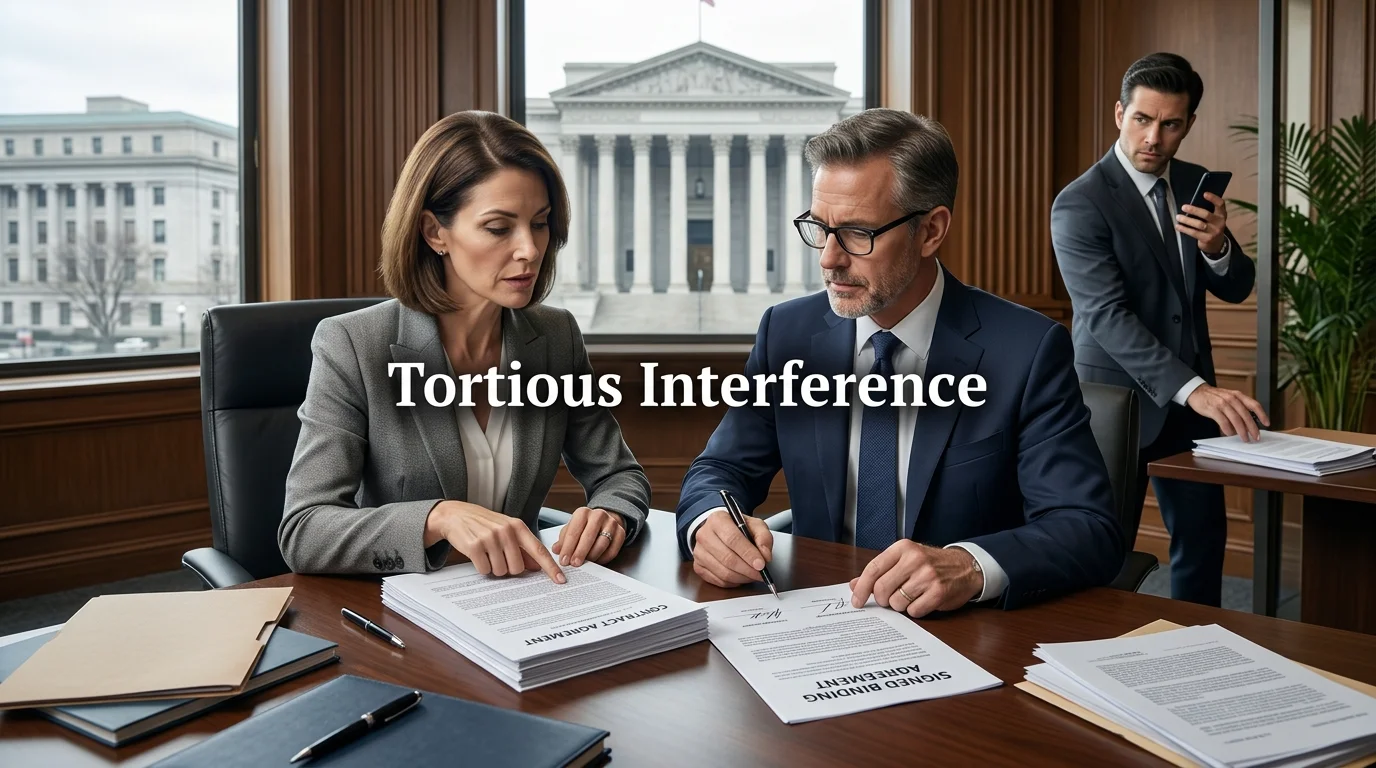
A competitor persuades a customer to walk away from a deal. A former employee pressures a supplier to stop doing business with their old company. An outsider knowingly disrupts a valuable commercial relationship and causes measurable financial loss. Depending on the facts and the state involved, conduct like this may raise a tortious interference claim.
The claim is part of U.S. common-law tort doctrine, and it generally protects contracts and certain business relationships from intentional, wrongful disruption by third parties. The important word is “wrongful,” because aggressive competition, persuasion, or pursuing the same customer does not automatically create liability. The precise legal test also varies from state to state, which makes the details of the relationship and the defendant’s conduct especially important.
Short answer: Tortious interference is a civil claim that may arise when a third party intentionally and wrongfully disrupts someone else’s contract or business relationship, causing financial harm. The exact elements vary by state, but courts commonly examine the protected relationship, knowledge, intent, wrongful conduct or lack of justification, causation, and damages.
What Is Tortious Interference?
Tortious interference generally means intentionally and wrongfully interfering with another person’s contractual or business relationship. Cornell Law School’s Legal Information Institute traces the doctrine to section 766 of the Restatement (Second) of Torts, which allows a damages claim against a third party who intentionally and improperly induces a breach of an existing contract. The same Restatement treats interference with a prospective contractual relation as a separate wrong under section 766B, and that split still shapes how U.S. states frame the two claims. Because the claim rests mainly on state common law, there is no single federal statute establishing one uniform test for every U.S. case.
The defendant is ordinarily an outsider to the relationship being disrupted rather than a party simply breaching its own contract. A contracting party may face a breach-of-contract claim for failing to perform, while an outside person or company that intentionally causes the disruption can potentially face a separate tort claim. Readers looking at related commercial legal issues can also browse Newsstact’s Law section for additional legal explainers.
| Key question | Why it matters |
|---|---|
| Was there an existing contract? | A valid contract can support a claim for interference with contractual relations. |
| Was there only an expected business opportunity? | A separate claim involving prospective economic or business relations may apply. |
| Did the defendant know about the relationship? | Knowledge is commonly required before intentional interference can be established. |
| Was the conduct wrongful or unjustified? | Legitimate competition and other privileges can defeat some claims. |
| Did the interference cause actual harm? | Plaintiffs generally need a causal connection and legally recoverable damages. |
Common Elements of an Interference Claim
There is no universal five- or six-element formula that applies identically in every state. Courts commonly examine several recurring issues, but jurisdictions differ over matters such as whether an actual contractual breach is necessary, what conduct qualifies as improper, and how justification is analyzed. Anyone evaluating a real dispute should therefore start with the law of the state governing the claim rather than relying solely on a generalized checklist.
1. A Valid Contract or Protectable Business Relationship
A contractual-interference claim normally begins with an enforceable contract or contractual right involving the plaintiff and another party. Prospective-business claims can be broader, but a vague hope of receiving future business is often insufficient without a recognizable relationship or reasonable probability of economic benefit. Florida, for example, requires an actual, identifiable business relationship rather than an undefined relationship with the general public.
2. The Defendant Knew About the Relationship
A person generally cannot intentionally interfere with a contract or commercial relationship they did not know existed. The required level of knowledge depends on the jurisdiction and circumstances, but courts commonly require proof that the defendant knew about the contract, relationship, or expectancy at issue. Emails, messages, negotiations, prior employment, business records, and direct communications can therefore become important evidence in a dispute.
3. The Interference Was Intentional
Accidental business disruption ordinarily does not fit the standard intentional-interference model. California’s 2026 civil jury instruction, for example, asks whether a defendant intended to disrupt contractual performance or knew that disruption was certain or substantially certain to result. The focus is therefore not merely on whether harm happened, but on what the defendant intended or understood when taking the challenged action.
4. The Conduct Was Wrongful, Improper, or Unjustified
Intent by itself does not necessarily create liability because ordinary businesses routinely compete for customers, employees, suppliers, and opportunities. Depending on the state and type of relationship, the plaintiff may need to establish wrongful means, lack of justification, independently unlawful conduct, or another heightened form of wrongdoing. New York, for instance, generally requires more culpable conduct for interference with prospective business relations than for interference with an existing enforceable contract.
5. The Conduct Actually Caused the Disruption
A plaintiff must generally connect the defendant’s conduct to the lost contract, disrupted relationship, or economic injury. A customer independently deciding not to renew an agreement may create a causation problem if the evidence does not show that the defendant actually produced the loss. Some states expressly use a “but for” causation concept in contractual-interference cases, requiring proof that the breach would not have occurred without the defendant’s conduct.
6. The Plaintiff Suffered Damages
Tort law generally requires an injury, not merely objectionable behavior. In a commercial dispute, the claimed loss might include profits that would have been earned under a contract, losses flowing from a disrupted transaction, or another provable economic injury permitted under applicable state law. The amount and type of compensation available depend on the jurisdiction, evidence, foreseeability, and the specific legal theory established.
Interference With a Contract vs. Prospective Economic Advantage

Two related claims are frequently grouped under this label, but they protect different interests. One focuses on an existing contractual relationship, while the other deals with a probable future business or economic relationship that has not necessarily become a binding contract. Courts may require stronger proof of wrongful conduct when the plaintiff seeks to protect a prospective opportunity rather than an existing enforceable right.
| Issue | Existing contract | Prospective economic or business relationship |
|---|---|---|
| Protected interest | Existing contractual rights | Probable future economic benefit or identifiable business relationship |
| Contract required? | Generally yes | Not necessarily |
| Defendant’s knowledge | Commonly required | Commonly required |
| Wrongful-conduct standard | Depends on state law | Often stricter because the opportunity is less certain |
| Required harm | Contractual disruption and resulting loss | Loss or disruption of the expected economic relationship |
California illustrates the distinction clearly. Its courts have explained that interference with prospective economic advantage requires an economic relationship containing a probability of future economic benefit, knowledge of that relationship, intentional wrongful acts designed to disrupt it, actual disruption, and resulting economic harm. California also requires independently wrongful conduct for this prospective-relations claim, showing that a business cannot assume ordinary competitive activity is actionable simply because it caused a deal to be lost.
Examples of Interference in Practice
Whether conduct is actionable depends on far more than whether another business lost money. Courts look at the nature of the relationship, the defendant’s knowledge and purpose, how the defendant acted, and whether the conduct was legally protected or privileged. The following simplified scenarios show where the issue may arise without suggesting that liability would automatically exist.
| Scenario | Why a claim might be considered |
|---|---|
| A competitor knowingly uses unlawful means to convince a customer to violate an exclusive supply agreement. | There is an existing contract, knowledge of it, alleged intentional interference, and possible economic harm. |
| A former executive deliberately pressures a key distributor to abandon a known agreement with the executive’s former company. | Knowledge and deliberate disruption of contractual performance may become central issues. |
| Someone makes fraudulent statements to destroy an identifiable pending commercial deal. | A prospective-business claim may be considered where state law recognizes the relationship and wrongful means can be proved. |
| A company intentionally disrupts another business’s valuable licensing arrangement to obtain the relationship for itself. | Existing rights, knowledge, intent, justification, causation, and damages could all become disputed issues. |
| A competitor simply offers a customer a lower price after the customer’s contract lawfully expires. | Normal competition may not be wrongful interference at all. |
Commercial disputes can also overlap with intellectual-property, licensing, confidentiality, or trade-secret questions. When the disputed relationship involves brands, inventions, software, confidential information, or licensing rights, Newsstact’s guide to what an intellectual property lawyer does provides useful background on those separate legal issues. The existence of another legal issue does not itself establish an interference claim, but several causes of action can sometimes arise from the same commercial conflict.
What Does Not Automatically Count as Interference?
Not every lost deal is a legal wrong. U.S. law generally leaves room for companies to compete, make better offers, recruit workers, negotiate with customers, and protect legitimate economic interests. A plaintiff therefore needs more than evidence that another company benefited after the plaintiff lost business.
| Situation | Why liability may be difficult to establish |
|---|---|
| A competitor offers better prices | Ordinary competitive conduct may be privileged or otherwise lawful. |
| A customer independently ends a relationship | The plaintiff may be unable to prove causation. |
| The defendant did not know about the contract | The knowledge and intent requirements may fail. |
| The expected deal was highly speculative | There may be no sufficiently protectable prospective economic relationship. |
| A party breaches its own agreement | The dispute may primarily sound in contract rather than third-party interference. |
| The challenged conduct was legally justified | A privilege or justification defense may apply under state law. |
Common Defenses to Interference Allegations
Defendants can challenge both the factual allegations and the claim’s legal sufficiency. A defendant might dispute the existence of an enforceable right, deny knowing about it, argue that its actions did not cause the loss, or show that the conduct was legitimate competition. Because standards vary by jurisdiction, a defense that succeeds in one state or factual setting cannot automatically be assumed to apply elsewhere.
| Defense or challenge | Basic argument |
|---|---|
| No valid contract | The plaintiff had no enforceable contractual right subject to interference. |
| No protected business expectancy | The alleged future opportunity was merely speculative or too general. |
| Lack of knowledge | The defendant did not know about the contract or relationship. |
| No intent | The disruption was incidental rather than intentional. |
| Legitimate competition | The defendant lawfully pursued its own commercial interests without prohibited means. |
| Legal or economic justification | The circumstances gave the defendant a recognized reason or privilege to act. |
| No causation | The relationship would have ended or the contract would have failed regardless of the defendant’s conduct. |
| No provable damages | The plaintiff cannot establish compensable loss caused by the alleged interference. |
What Damages Can Be Available?
The purpose of compensatory damages is generally to address losses legally caused by the wrongful interference. Depending on governing law and available proof, a plaintiff may seek lost profits or other economic losses flowing from the disrupted contract or relationship. Courts generally require damages to be supported with evidence rather than based only on speculation about what a business might have earned.
Additional remedies can depend heavily on state law and the conduct involved. Punitive damages may be available in some jurisdictions when separate legal requirements for that form of recovery are met, but they are not automatic merely because interference was intentional. Businesses evaluating the financial side of a dispute should separate actual documented losses from projected opportunities that may be difficult to prove.
Why State Law Can Change the Result
These claims largely turn on state law, and significant differences exist between jurisdictions. California, New York, Florida, and Texas all recognize interference-related claims, yet their courts phrase the required elements and limitations differently. That variation is why a generic internet checklist should be treated as an introduction, not a substitute for researching the governing jurisdiction.
| State example | Important point |
|---|---|
| California | The 2026 contractual-interference jury instruction addresses intentional disruption, harm, and substantial-factor causation; prospective economic advantage has additional wrongful-conduct requirements. |
| New York | Existing-contract claims and prospective-business claims have different standards, with prospective claims generally requiring more culpable conduct. |
| Florida | A business relationship need not always rest on an enforceable contract, but courts require a sufficiently identifiable relationship rather than a broad hope of future customers. |
| Texas | The Texas Supreme Court describes an existing-contract claim as a contract subject to interference, willful and intentional interference, causation, and actual damage or loss. |
For example, the New York Court of Appeals identifies a valid third-party contract, knowledge, intentional procurement of the breach without justification, actual breach, and resulting damages as elements of contractual interference under New York law. California’s jury instruction is phrased differently and can address conduct that prevents performance or makes it more expensive or difficult. These distinctions can materially affect whether the same commercial conduct produces a viable claim in one jurisdiction and a weaker claim in another.
What Evidence Matters in a Business-Interference Dispute?
These cases can turn on documents showing what relationship actually existed and what the alleged interferer knew. Contracts, purchase orders, emails, text messages, customer communications, pricing records, internal messages, termination notices, financial statements, and negotiation histories may help establish or challenge the relevant elements. Preserving original records can be especially important when the dispute concerns what happened before a customer, supplier, employee, or prospective partner changed course.
A business facing a serious dispute should usually avoid deleting communications or reconstructing the record after the fact. It is also useful to separate evidence of ordinary competition from evidence suggesting threats, deception, unlawful conduct, or deliberate inducement of a contractual violation. Newsstact’s Business section covers broader issues affecting companies and commercial operations.
A practical response can be organized into five steps:
Identify the exact relationship that was disrupted. Determine whether it was a signed contract, an at-will arrangement, an ongoing customer relationship, or a prospective transaction.
Preserve communications and contracts. Keep relevant emails, messages, agreements, invoices, proposals, and notices in their original form.
Build a timeline. Record when the defendant allegedly learned about the relationship, what actions followed, and when the relationship changed.
Document the financial effect. Separate provable lost revenue, profits, expenses, and other measurable harm from estimates that cannot yet be supported.
Check the governing state law. Identify which jurisdiction applies before assuming that a general tortious interference test controls the dispute.
The timeline can matter because knowledge, intent, causation, and damages often depend on the sequence of events. Evidence that a relationship was already collapsing before the defendant became involved may weaken causation, while communications showing deliberate efforts to trigger a breach may support the plaintiff’s theory. The strength of a case ultimately depends on admissible facts, not simply on how unfair the business conduct appeared.
When Should a Business Speak With a Lawyer?
Legal advice matters more when a significant contract is disrupted, substantial revenue is at stake, litigation is threatened, or important evidence could disappear. An attorney can analyze which state’s law applies, whether the underlying relationship is legally protected, and whether the conduct fits an interference claim or another cause of action. Early analysis can also help a business avoid sending accusations or taking retaliatory steps that create additional legal problems. You might also like How to Get Out of a Lease Early.
Frequently Asked Questions
Is tortious interference a crime?
This kind of interference is generally a civil tort rather than a standalone criminal offense. A successful plaintiff ordinarily seeks civil remedies such as damages rather than asking a court to impose criminal punishment for the tort itself. However, the conduct at issue in an interference dispute could separately violate criminal or regulatory laws, depending on what happened.
Do you need a written contract to sue for interference?
Not in every type of interference claim. Interference with an existing contract generally requires a legally protected contractual relationship, but prospective-business claims can sometimes protect identifiable economic relationships even without a final written contract. The exact threshold depends on state law and whether the claimed relationship was sufficiently concrete rather than speculative.
Can a competitor be sued for taking a customer?
Simply winning a customer from another business normally does not establish liability. Competition can be lawful even when it causes another company to lose revenue, and courts often distinguish ordinary persuasion or better commercial offers from prohibited wrongful conduct. The answer becomes more complicated when the competitor knowingly targets existing contractual rights or uses unlawful or independently wrongful means.
Can an interference claim involve an at-will relationship?
Potentially, but the legal treatment varies by state. Because an at-will relationship can ordinarily be terminated, some courts give it less protection than a fixed contractual obligation and analyze interference under principles associated with prospective economic advantage. The defendant’s methods and any competition privilege can therefore become especially important.
What is the difference between breach of contract and interference?
A breach-of-contract action typically concerns a party that failed to perform its own contractual obligation. An interference action ordinarily concerns an outside person or company whose wrongful conduct disrupted the plaintiff’s contract or business relationship with someone else. The same commercial dispute can sometimes generate multiple legal claims, but each claim has its own required elements and defenses.
How hard is an interference claim to prove?
The difficulty depends on the available evidence and governing state law. A plaintiff may need to establish the protected relationship, the defendant’s knowledge and intent, legally wrongful or unjustified interference where required, causation, and measurable damages. Claims based only on suspicion that a competitor “stole” business can be much weaker than cases supported by contracts, communications, financial evidence, and proof directly connecting the defendant to the disruption.
The Bottom Line
Tortious interference protects certain contracts and business relationships from wrongful third-party disruption, but it does not prohibit normal competition. The strongest claims generally involve a clearly identifiable relationship, evidence that the defendant knew about it, intentional conduct meeting the applicable state standard, a demonstrable causal connection, and provable economic harm. Because U.S. states define and limit these claims differently, the governing jurisdiction can be just as important as the basic facts of the dispute.
